Luke 12,13-34

The Parable of the Rich Fool
(Luke 12:13–21)
13 Someone in the crowd said to him, “Teacher, tell my brother to divide the inheritance with me.”
14 But he said to him, “Man, who made me a judge or arbitrator over you?”
15 And he said to them, “Take care, and be on your guard against all covetousness, for one’s life does not consist in the abundance of his possessions.”
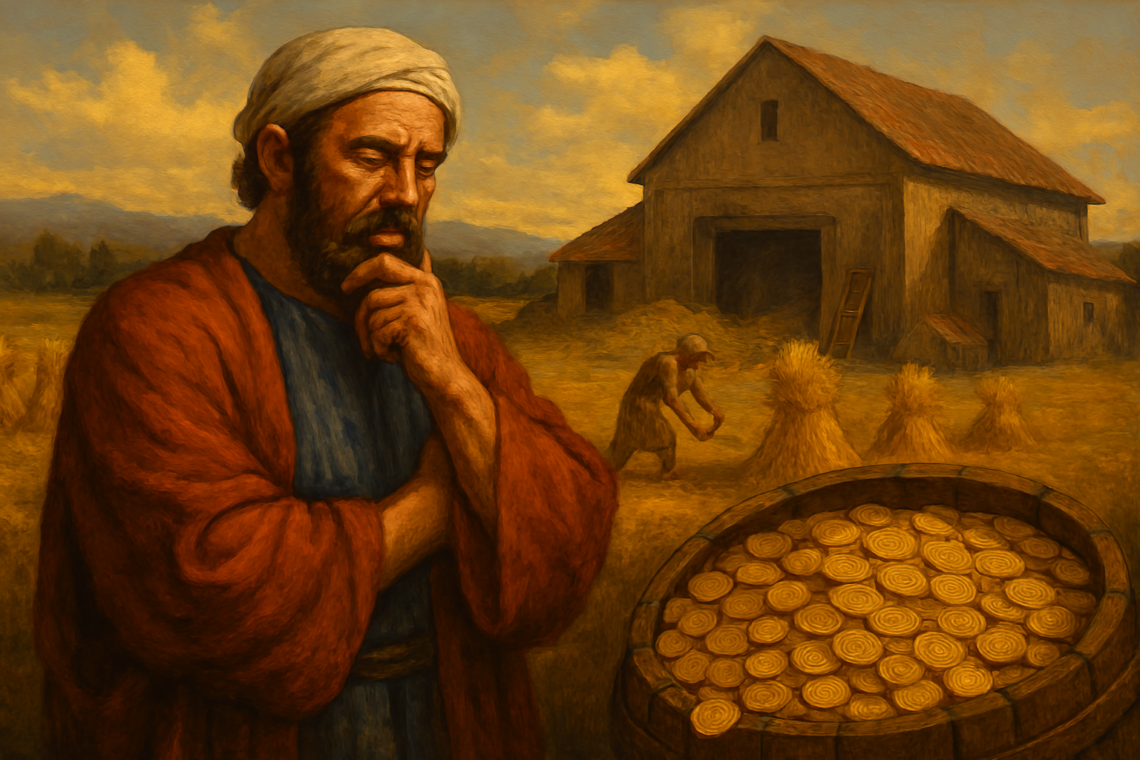
16 And he told them a parable, saying, “The land of a rich man produced plentifully,
17 and he thought to himself, ‘What shall I do, for I have nowhere to store my crops?’
18 And he said, ‘I will do this: I will tear down my barns and build larger ones, and there I will store all my grain and my goods.
19 And I will say to my soul, “Soul, you have ample goods laid up for many years; relax, eat, drink, be merry.”’
20 But God said to him, ‘Fool! This night your soul is required of you, and the things you have prepared—whose will they be?’
21 So is the one who lays up treasure for himself and is not rich toward God.
Do Not Be Anxious
(Luke 12:22–34)
22 And he said to his disciples, “Therefore I tell you, do not be anxious about your life, what you will eat, nor about your body, what you will put on.
23 For life is more than food, and the body more than clothing.
24 Consider the ravens: they neither sow nor reap, they have neither storehouse nor barn, and yet God feeds them. Of how much more value are you than the birds!
25 And which of you by being anxious can add a single hour to his span of life?
26 If then you are not able to do as small a thing as that, why are you anxious about the rest?
27 Consider the lilies, how they grow: they neither toil nor spin, yet I tell you, even Solomon in all his glory was not arrayed like one of these.
28 But if God so clothes the grass, which is alive in the field today and tomorrow is thrown into the oven, how much more will he clothe you, O you of little faith!
29 And do not seek what you are to eat and what you are to drink, nor be worried.
30 For all the nations of the world seek after these things, and your Father knows that you need them.
31 Instead, seek his kingdom, and these things will be added to you.
32 “Fear not, little flock, for it is your Father’s good pleasure to give you the kingdom.
33 Sell your possessions, and give to the needy. Provide yourselves with moneybags that do not grow old, with a treasure in the heavens that does not fail, where no thief approaches and no moth destroys.
34 For where your treasure is, there will your heart be also.
Introduction
Hello everyone, I am Kiki.
The Chinese name of the second phase of our program is 《读经大讲堂》, and the English name is “Bible Study.”
We adopt a relaxed and enjoyable learning approach to lead you into a new learning world. In each session, I will share a personal summary and analysis from the perspective of a learner. Then Sister Ingrid will help us go deeper through discussion and problem exploration together.
We hope that this interactive and engaging process will bring you a fresh learning experience.
Below is my discussion with Sister Ingrid on today’s topic.
Today is the 34th lecture on the Gospel of Luke.
Everyone is welcome to leave comments for discussion!
2. My Summary of the 34th Study of Luke
Well, everyone! First, here is my personal study summary for today.
This passage contains two main teachings from Jesus: one about money, and one about worry.
First, a man asks Jesus to make his brother share the family inheritance. Jesus refuses and warns against greed. He tells everyone that life does not consist in possessions.
Jesus then tells the parable of a rich farmer who receives an abundant harvest. Instead of sharing or thanking God, the man builds bigger barns to store everything for himself, planning to relax and enjoy life for many years. But God calls him a fool, because that very night his life ends, and all his possessions are left behind.
Next, Jesus teaches his disciples not to worry about food or clothing. He points to the birds and the flowers—God takes care of them, and human beings are far more valuable. Worry does not help at all. Instead of living like the nations who are consumed by anxiety, we are called to seek God’s kingdom first.
Finally, Jesus gives radical advice: be generous. Sell possessions and give to the poor. This is investing in treasure in heaven that never fades. In short, Jesus calls us to replace greed and worry with trust in God and generosity toward others. This is what true and secure life looks like.
Now, Sister Ingrid will take the summary a step further.
3. Sister Ingrid’s Commentary
As you mentioned, the passage begins with a man asking Jesus to solve a financial dispute. Jesus refuses, explaining that it is not his role to act as a judge or arbitrator, and he warns against greed, saying that life does not consist in having many possessions.
To illustrate this, Jesus tells the parable of the rich fool. The man enjoys a great harvest and plans to store it in new barns so that he can live many years in luxury. But God says to him, “Fool! This very night your soul is demanded of you.”
Afterward, Jesus explains how we should deal with worry and what our true priorities should be. There is no need to worry, because God takes care of us just as he takes care of the ravens and the flowers.
The nations of the world worry about these things, but we do not need to. We can give boldly and store up treasure in heaven, because our Father in heaven takes care of us. Where our treasure is, there our heart will be also.
4. Question List Based on Luke, Lecture 34
Based on today’s Bible study, I asked Sister Ingrid the following questions.
We hope these questions will be helpful for brothers and sisters who are new to the Christian faith.
1. Why did Jesus refuse to help the man divide the inheritance?
Jesus said it was not his role, because he was not appointed as a judge or arbitrator.
2. What does “covetousness” mean, and why should we guard against it?
It can be understood as greed—the desire to have more and more without contentment.
3. What was the rich man’s plan after the great harvest?
He planned to build large barns to store everything and then live in luxury for many years without working.
4. Why did God call the rich man a “fool”?
Because the man failed to consider that life is fragile and that death can come at any moment.
5. What does it mean to be “rich toward God”?
Being rich toward God means using the opportunities God gives us—helping those in need, sharing what we have, and spreading the gospel. God gives us many opportunities, and we should use them faithfully to multiply what he has entrusted to us.
In today’s passage, giving and trusting God instead of worrying are central themes.
6. What examples from nature does Jesus use to teach against worry?
God feeds the ravens and clothes the grass of the field.
7. Can worrying help us live longer or solve our problems?
No. As Ecclesiastes teaches, we have no power over the hour of our death. We must be prepared at all times, because death does not discriminate between young and old.
8. What does God’s care for birds and flowers show us about his care for us?
It shows that we are far more valuable to God, and therefore we can fully trust in him.
9. What should we seek first, and what is the promise?
We should seek heavenly treasure. Where our treasure is, there our heart will be also.
10. What does “where your treasure is, there your heart will be also” mean?
If we are greedy, our hearts are tied to earthly possessions. But when we are generous and trust God to provide for us, our hearts are focused on heaven. This generosity is evidence of where our true treasure lies.