John 8,12-20


Dispute Over Jesus’ Testimony
12 When Jesus spoke again to the people, He said, “I am the light of the world. Whoever follows Me will never walk in darkness, but will have the light of life.”
13 The Pharisees challenged Him, “Here You are, appearing as Your own witness; Your testimony is not valid.”
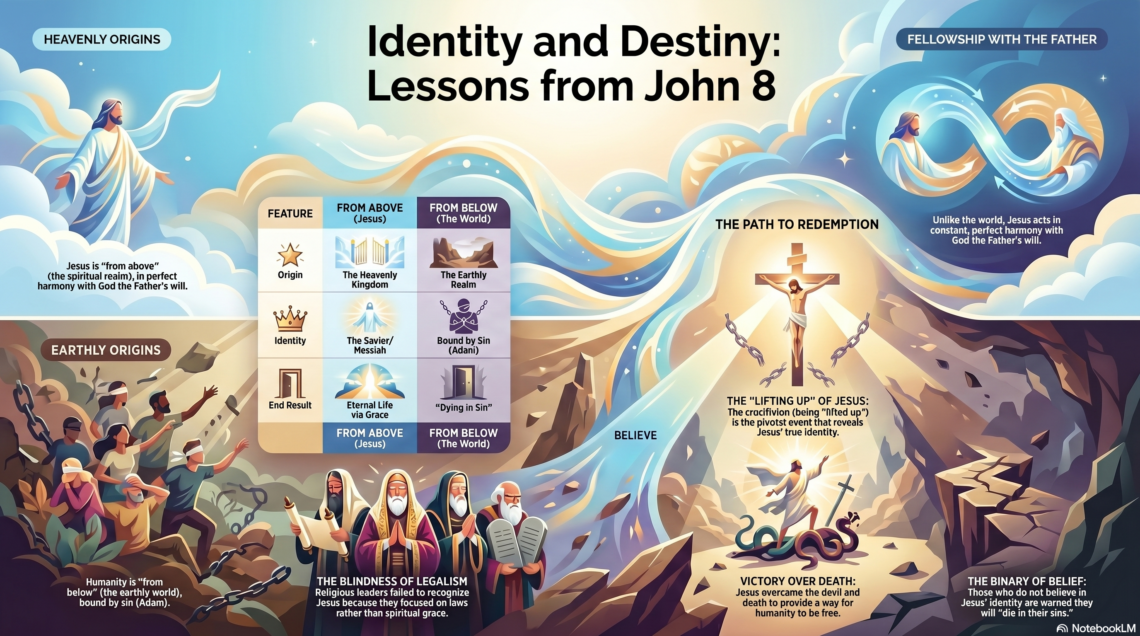
14 Jesus answered, “Even if I testify on My own behalf, My testimony is valid, for I know where I came from and where I am going. But you have no idea where I come from or where I am going.
15 You judge by human standards; I pass judgment on no one.
16 But if I do judge, My decisions are true, because I am not alone. I stand with the Father, who sent Me.
17 In your own Law it is written that the testimony of two witnesses is true.
18 I am one who testifies for Myself; My other witness is the Father, who sent Me.”
19 Then they asked Him, “Where is Your Father?”
“You do not know Me or My Father,” Jesus replied. “If you knew Me, you would know My Father also.”
20 He spoke these words while teaching in the temple courts near the place where the offerings were put. Yet no one seized Him, because His hour had not yet come.
Hello Everyone
Hello everyone, I am Kiki. The Chinese name of the second phase of our program is “读经大讲堂”. The English name is “Bible Study.”
We will adopt a relaxed and enjoyable learning approach to take you into a new world of learning. Each time, I will share my personal summary and analysis from the perspective of a learner, and then Sister Ingrid will help me explore the passage in greater depth through discussion with everyone.
I hope this interesting and interactive format will bring all of you a new learning experience. The following is my interview with Sister Ingrid on today’s topic. Today is the 14th study of the Gospel of John.
Everyone is welcome to leave a message in the comment section for discussion!
My Summary of the 14th Study of John
Hello, everyone! Here is my Bible study summary for today.
In this passage, Jesus tells the people that He is the Light of the world.
He says that whoever follows Him will never walk in darkness but will have the light of life.
The Pharisees, who were the religious leaders of that time, did not believe Jesus. They challenged His testimony, saying that He could not testify about Himself.
Jesus answered that His testimony was true because He knew where He had come from and where He was going. He also explained that He did not judge by human standards and that, whenever He judged, His judgment was true because He was not alone—the Father who sent Him was with Him.
Jesus reminded them that according to their own Law, the testimony of two witnesses is valid. He declared that He Himself was one witness and that His Father was the other.
When the Pharisees asked Him, “Where is Your Father?”, Jesus replied that if they truly knew Him, they would also know His Father.
Although the Pharisees questioned Him, they did not arrest Him because His appointed time had not yet come.
I think this passage teaches us that Jesus is the Light and the Truth. By following Him, we can live in God’s light and find the true meaning of life.
Now let Sister Ingrid explain this Bible passage in greater depth.
Sister Ingrid’s Comment on My Study Summary
Hello everyone,
The outstanding point in this passage is that Jesus is the Light, and everyone who follows Him will walk in the light of life.
This means that when we follow Jesus, we do not need to remain in spiritual darkness or confusion, because He gives us a deep understanding of spiritual truth.
The religious leaders were not walking in God’s light. Therefore, they demanded human proof and accused Jesus of not having valid witnesses. As you mentioned, Jesus answered that there were indeed two witnesses: Himself and His Father.
Finally, Jesus told the religious leaders that it was impossible for them to understand because only those who know Jesus know the Father, and those who know the Father also know Jesus.
Q&A List Based on the 14th Study of John
Okay. Based on today’s Bible study, let me now ask Sister Ingrid some related questions.
We hope the following questions will be helpful to our brothers and sisters who have recently become Christians.
1. Sister, what does Jesus mean when He says, “I am the light of the world”? How does this metaphor help us understand His role and mission?
When Jesus says, “I am the light of the world,” it implies that there is darkness in the world.
The darkness of this world is represented by the devil and the demons, who gained access to the world through the sin of Adam and Eve.
At that moment, the wonderful relationship between God and humanity was broken. The devil became the ruler of this world, and evil and darkness spread everywhere.
When Jesus came, the Kingdom of God came with Him to bring light to humanity and to make it possible for people to be reconciled with God and have a peaceful, forgiven relationship with Him.
2. Why do the Pharisees challenge the validity of Jesus’ testimony? What cultural or legal standards are they referring to?
In the previous event, Jesus showed that He stood above the Law of Moses by not condemning the woman caught in adultery to death by stoning.
Now the Pharisees accuse Him of acting without authority because He had not studied in one of their religious schools and therefore, in their opinion, had no authority to interpret or stand above the Law of Moses.
3. How does Jesus defend the validity of His testimony? What does He mean when He says He knows where He came from and where He is going?
Jesus explains that His testimony comes directly from God. He knows that He was sent from heaven and that He will return to heaven again.
4. What distinction does Jesus make between human judgment and His own judgment? How does this relate to His relationship with the Father?
Human judgment is based on outward appearances. We judge only by what our eyes can see, but we do not know the deeper circumstances or the intentions of a person’s heart.
As I mentioned in the previous podcast, we know very little about the woman caught in adultery. We do not know why she committed adultery, what her marriage was like, or what circumstances led to her sin.
Jesus says that He does not judge those who follow Him, because they will not stand before the great white throne of judgment described in the Book of Revelation. Instead, they pass into eternal life.
When that final judgment comes, Jesus will judge together with the Father. Their judgment will be perfectly righteous because the Father knows everything.
5. Jesus refers to the Law that says the testimony of two witnesses is true. Where do we find this law in the Old Testament, and why is it important here?
This law is found in Numbers 35:30 and Deuteronomy 17:6. In those passages it refers to capital punishment, requiring two or more witnesses before someone could be sentenced to death.
In Deuteronomy 19:15, the principle is extended to all kinds of legal matters, stating that no accusation can be established on the testimony of only one witness.
6. Who does Jesus identify as His two witnesses, and how does this support His testimony?
Jesus says that His testimony is true because both He and His Father in heaven testify about Him.
7. What is the significance of the Pharisees asking, “Where is Your Father?” How does Jesus’ answer deepen our understanding of His relationship with the Father?
Jesus and the Father are one. Whoever truly knows Jesus also knows the Father. Seeing Jesus reveals the Father.
8. Why is it significant that Jesus was teaching in the temple courts? Why was He not arrested at that moment?
The temple was a holy place, and not everyone was permitted to teach there. Temple guards ensured that unauthorized people did not teach.
Jesus was not arrested because the appointed time for His sacrifice had not yet come. Later, when His hour arrived, He willingly gave His life for us.
9. What does this passage reveal about Jesus’ mission and His relationship with the Father? How can this strengthen a Christian’s faith?
Jesus’ mission is to be the Light of the world and to destroy the works of the devil. The Father sent Him because He loves us and does not want anyone to perish but to have eternal life.
Romans teaches that if we believe in our hearts and confess with our mouths, we will be saved.
What should we believe and confess? That Jesus is the Son of God and that God raised Him from the dead to save us.
10. How can Jesus’ claim to be the Light of the world guide a Christian’s daily life? What practical steps help us follow this Light?
Jesus is now in heaven, seated at the right hand of the Father. But Christians are not orphans. We have the Holy Spirit living within us, and He guides and leads us.
The first practical step is to leave the kingdom of darkness behind, repent of our sins, confess them to God the Father, and ask for forgiveness in Jesus’ name.
Then we begin to follow Jesus.
Our daily task is to learn to recognize the voice of the Holy Spirit. When we are about to make a wrong decision or commit a sin, the Holy Spirit warns us.
This warning does not always come through an audible voice. It may come through a Bible passage we are reading, through the advice of a mature Christian, a trusted friend, or even through someone we do not naturally like—but whom God chooses to speak through.
The more we learn to listen and obey, the easier it becomes to follow Jesus and to grow into a personal relationship with Him, where He truly becomes the Light of our lives.
10. Hvordan kan Jesu utsagn om at han er verdens lys, veilede en kristen i hverdagen? Hvilke praktiske skritt kan vi ta for å følge dette lyset?
Jesus er nå i himmelen og sitter ved Faderens høyre hånd. Men kristne er ikke foreldreløse. Vi har Den hellige ånd som bor i oss, og han veileder og leder oss.
Det første praktiske skrittet er å vende ryggen til mørkets rike, omvende oss fra våre synder, bekjenne dem for Gud Faderen og be om tilgivelse i Jesu navn.
Deretter begynner vi å følge Jesus.
Vår daglige oppgave er å lære å gjenkjenne Den hellige ånds stemme. Når vi står i fare for å ta en feil beslutning eller begå en synd, advarer Den hellige ånd oss.
Denne advarselen kommer ikke alltid gjennom en hørbar stemme. Den kan komme gjennom et bibelavsnitt vi leser, gjennom råd fra en moden kristen, en venn vi har tillit til, eller til og med gjennom en person vi kanskje ikke naturlig liker – men som Gud velger å tale gjennom.
Jo mer vi lærer å lytte og være lydige, desto lettere blir det å følge Jesus og vokse inn i et personlig forhold til ham, der han virkelig blir lyset i våre liv.