Podcasts/ Transcr. CN

Lukas 14,25-35

The Cost of Discipleship
25 Now great crowds accompanied him, and he turned and said to them,
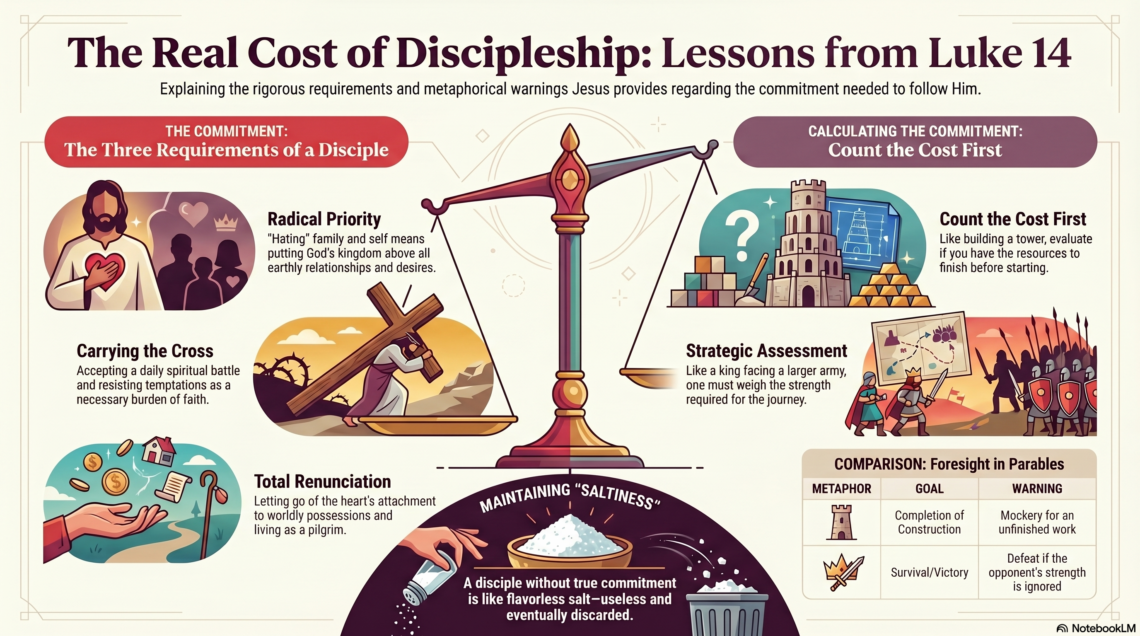
26 “If anyone comes to me and does not hate his own father and mother and wife and children and brothers and sisters, yes, and even his own life, he cannot be my disciple.
27 Whoever does not bear his own cross and come after me cannot be my disciple.
28 For which of you, desiring to build a tower, does not first sit down and count the cost, whether he has enough to complete it?
29 Otherwise, when he has laid a foundation and is not able to finish, all who see it begin to mock him,
30 saying, ‘This man began to build and was not able to finish.’
31 Or what king, going out to encounter another king in war, will not sit down first and deliberate whether he is able with ten thousand to meet him who comes against him with twenty thousand?
32 And if not, while the other is still a great way off, he sends a delegation and asks for terms of peace.
33 So therefore, any one of you who does not renounce all that he has cannot be my disciple.

Salt Without Taste Is Worthless
34 “Salt is good, but if salt has lost its taste, how shall its saltiness be restored?
35 It is of no use either for the soil or for the manure pile. It is thrown away. He who has ears to hear, let him hear.”


Hello everyone, I am Kiki. The Chinese name of our second phase of the program is “读经大讲堂”. The English name is “Bible Study.”
We will adopt a relaxed and enjoyable learning mode to take you into a new world of learning. Each time, I will make a personal summary and analysis from the perspective of a learner, and then Sister Ingrid will help me conduct in-depth learning and discussions with everyone.

I hope that such an interesting and interactive process can bring a new learning experience to all of you. The following is my interview with Sister Ingrid on related issues. Today is the 41st lecture on the Gospel of Luke.
Everyone is welcome to leave a message in the comment section for discussion!


2. My summary of the 41st study of Luke:

Well, everybody! First of all, here is my personal study summary for today.

Following Jesus costs a lot.
He says you must love him more than anyone, even your family.
That’s what “hate” means here—love less. You must also be ready to suffer or die for him. That’s what “carry your cross” means.

Jesus gives two examples. First, a man who builds a tower.
He counts the cost first. If he can’t finish it, people will laugh at him.
Second, a king who goes to war. He checks if he can win. If not, he makes peace.

So, don’t start following Jesus without thinking about the cost.
The cost is everything you have. You must be willing to give it all up if needed.

Then Jesus talks about salt.
Good salt keeps its flavor. If it loses its flavor, it is useless and gets thrown away. A disciple who doesn’t truly follow Jesus is like useless salt.

So, think carefully: Is following Jesus worth it?
He says yes—but be honest about the cost.

Now let Sister Ingrid give a further summary.


3. Sister’s comment on my study summary:

Hello, we have here a big crowd of people who gathered around Jesus Christ. But the question is: who among them is able to become a disciple? The description Jesus gives of a disciple is like the description of the requirements for a new job.

A disciple should “hate” his mother and father, his brothers, his wife, his children, and even himself. That sounds harsh, but as Kiki already mentioned, this does not mean emotional hatred, but setting the right priorities.

If we compare it with an earthly soldier, this becomes clearer. A soldier may stay with his family as long as there is no war or crisis in the country. But if there is tension or war begins, the soldier must go to the place assigned to him.

So, we may love our families, but when spiritual tension arises, we must first of all be true disciples of Christ—those who give everything, not those who confess their faith only with their mouths.

To describe discipleship, Jesus uses the picture of a tower. Before you start building, you first calculate the cost. If you do not have enough money, you do not build.

Or if a king goes to war against a more powerful king, it is better to negotiate peace before losing the war.

Then Jesus uses the picture of salt again. He said before that the disciples are the salt of the earth. And here he says that salt which has lost its saltiness is only good to be thrown out.

This is a warning for those who want to become disciples but do not continue walking on the path of discipleship.


4. Q list part: based on the 41st study of Luke:

Okay, based on the above Bible study content, let me ask Sister Ingrid some related questions.
We hope the following questions will be helpful to our brothers and sisters.


1. Why did Jesus say you must “hate” your family? Does he mean real hate?
No, when we hear “hate,” we think of negative emotions. But he did not mean that. He is talking about setting the right priorities.


2. What does “carry your cross” mean?
It means taking up the daily struggle, which is not always easy, because we are in a spiritual battle. Standing firm every day against attack and temptation can be a heavy burden.


3. Why does a builder first count the cost before building a tower?
Because he needs to know if he is able to finish it. It is shameful to leave a tower half-finished.


4. What happens if you start building but can’t finish?
如果你开始盖塔却盖不完,会怎样?
People will mock you and laugh at you.


5. If you are a king with 10,000 soldiers facing 20,000 enemies, what should you do first?
You should calmly consider whether you are able to stand against such a large army. The best option may be to negotiate peace.


6. Why does Jesus compare following him to going to war?
Because we are in a spiritual battle between the kingdom of heaven, where we belong, and the kingdom of darkness, where the devil and demons are.


7. Does “renounce all you have” mean throwing away your possessions?
No, it means having as though not having. For example, if you are married, you should not hold on as if it were eternal.

One day, one of you will die, and the other will remain alone. If you have a house, it can burn down; if you have a car, it can crash, and so on. You may have possessions, but you should not set your heart on them.


8. How can salt lose its taste? What does that teach us?
盐怎么会失味?这教给我们什么?
If we no longer continue being “salt” in this world, we become worthless, and God cannot use us for good purposes anymore.


9. Why does Jesus say, “He who has ears, let him hear”? Everyone has ears.
In another part of the Bible, Jesus says that some people have hearts that have become dull because they have heard so much but learned nothing. The prophet Isaiah already spoke of ears that are not able to hear.


10. What is the cost of being Jesus’ disciple?
It costs everything. In the Western world, we live relatively comfortable lives and are not directly persecuted. But this can also be our greatest danger: when we are spiritually asleep, the devil can tempt us easily and put our salvation at risk.

So we must each decide whether we are willing to pay the cost and live like pilgrims on a narrow path that leads to heaven, or whether we remain listeners in a crowd—wanting to feel religious but never truly committing to the kingdom of our Lord Jesus Christ.

留言

您的邮箱地址不会被公开。 必填项已用 * 标注