John 4,43-54

43 After the two days he left for Galilee.
44 (Now Jesus himself had pointed out that a prophet has no honor in his own country.)
45 When he arrived in Galilee, the Galileans welcomed him. They had seen all that he had done in Jerusalem at the Passover Festival, for they also had been there.
46 Once more he visited Cana in Galilee, where he had turned the water into wine. And there was a certain royal official whose son lay ill at Capernaum.
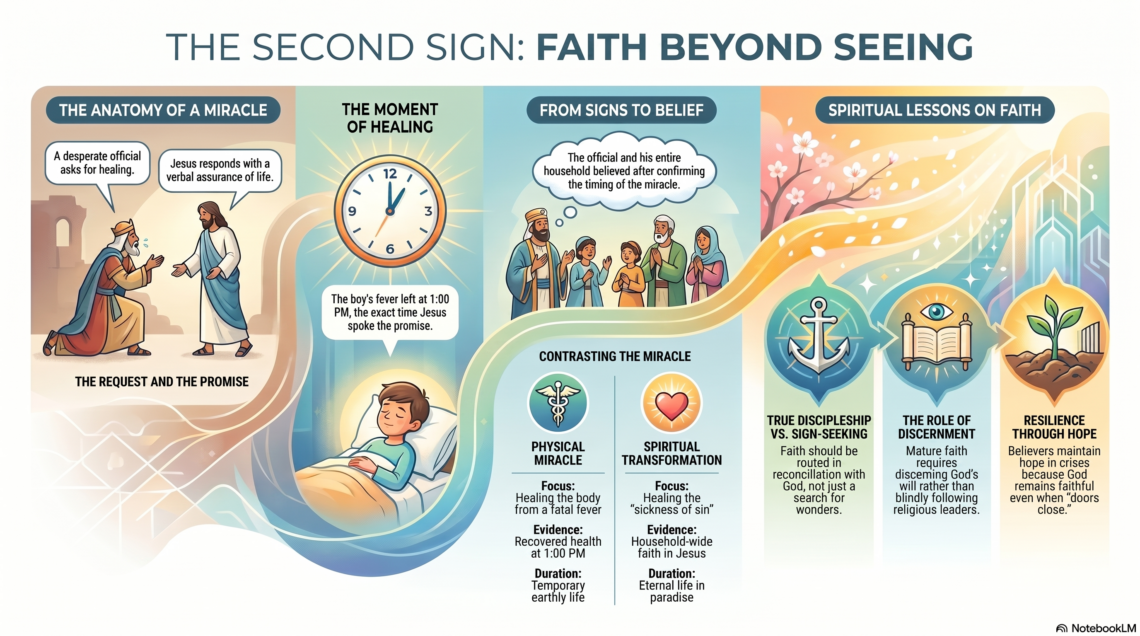
47 When this man heard that Jesus had arrived in Galilee from Judea, he went to him and begged him to come and heal his son, who was close to death.
48 ‘Unless you people see signs and wonders,’ Jesus told him, ‘you will never believe.’
49 The royal official said, ‘Sir, come down before my child dies.’
50 ‘Go,’ Jesus replied, ‘your son will live.’ The man took Jesus at his word and departed.
51 While he was still on the way, his servants met him with the news that his boy was living.
52 When he enquired as to the time when his son got better, they said to him, ‘Yesterday, at one in the afternoon, the fever left him.’
53 Then the father realized that this was the exact time at which Jesus had said to him, ‘Your son will live.’ So he and his whole household believed.
54 This was the second sign Jesus performed after coming from Judea to Galilee.
Hello everyone, I am Kiki. The Chinese name of our second phase of the program is “读经大讲堂”. The English name is “Bible Study”.
We will adopt a relaxed and enjoyable learning mode to take you into a new world of learning. Each time, I will make a personal summary and analysis from the perspective of a learner, and then Sister Ingrid will help me conduct in-depth learning and discussion of questions with everybody.
I hope that such an interesting and interactive process can bring a new learning experience to all of you. The following is my interview with my sister on related issues. Today is the eighth lecture on the Gospel of John. Everyone is welcome to leave a message in the comment area for discussion!
2. My summary of the eighth John study:
Hello everyone, below is my fundamental summary.
Jesus, as a very special person who could do amazing things in that distant historical time, went back to his old home in Galilee after doing great things in Jerusalem during a big celebration called the Passover Festival.
Even though he was from there, people did not really respect him as a prophet should be respected in his own hometown.
But when the locals saw what he had done in Jerusalem, they were excited and welcomed him warmly.
Jesus went to a place in Galilee where he had once changed water into wine.
There, a very important person whose son was very sick asked him to come and heal his son.
Jesus said that some people need to see amazing signs in order to believe.
The worried father kept asking Jesus to help before it was too late.
Jesus told the man that his son would get better, and the man believed him and started walking home.
On his way, some servants met him with the good news that his son was already feeling better.
They said the boy got better the day before at a certain time in the afternoon. The father realized that this was exactly when Jesus had said that his son would be okay.
So, the father and everyone in his family started to believe in Jesus because of this miracle.
This story of the sick boy getting better was considered the second special sign that Jesus performed after coming back from Judea to Galilee.
Now let Sister Ingrid make a summary of my Bible study.
3. Sister’s comment on my study summary:
(around 350–500 words or less, you decide it)
Hello sister, your summary was very good. People who had heard about Jesus before expected that he could meet their needs too. That is why this royal official came to Jesus to ask him for help.
The Bible also mentioned one important thing: when we experience a miracle, we should investigate when it happened and maybe get testimony from a doctor to confirm that it was a supernatural healing, so that we can give glory to God for what he has done.
4. Q list part: based on the eighth chapter of John
Okay, based on the above Bible study content, now let me ask sister some related questions.
1. How do modern-day people typically perceive miracles or signs from a religious or spiritual perspective?
Sister, what do you think of the miracles Jesus performed?
The problem with miracles today is the same as it was in the time of Jesus: when people see many miracles, they search for the miracle itself but not for reconciliation with God through the blood of Jesus, which he gave on the cross.
Jesus knew that there were many people around him with this motivation, and that is why he often criticized people for believing only because of miracles.
But at the same time, Jesus had mercy on the people. He said that they were like sheep without a shepherd, and many miracles he performed were done because of his mercy for the people.
2. In what ways do people today seek healing or miracles for themselves or their loved ones? And what is your way of healing?
We are living in a religious age. People search for God because of blessings and healings. But Jesus is more than a healer. He heals us from a sickness that nobody on earth can heal: the sickness of sin, and the price of sin is death.
Jesus gives us eternal life, and even if our body dies here on earth, our soul will live in paradise with Jesus. The day will come when Jesus will restore our body from the grave, and we will be created once again to live with him as complete persons in heaven.
There is nothing wrong with praying to Jesus when we are sick. James says that we should call the elders of our church when somebody is sick. But in the same sentence, he says that the person will be saved; he does not say healed.
3. What role do beliefs in supernatural intervention play in people’s coping mechanisms during times of crisis or illness?
When people believe in God, they do not lose hope as easily as non-believers.
I once read a book written by a medical doctor who witnessed that people who believe have more hope and better health outcomes during sickness. He observed that every kind of supernatural belief can help, but especially Christians recovered their health sooner than other people after illness.
4. How do societal attitudes toward individuals with special abilities or powers differ across different cultures and communities today?
Sister, are you frustrated because your power is not fully utilized?
No, I am not frustrated about this. The Word of God says that nobody can take something that heaven has not given him. We should understand that nothing depends on us; everything is given by God.
When I do something for God, sometimes it is better to step back and leave my place to another person. It may be that the person has less power or qualification, but others should also have a chance to develop themselves.
5. How does the concept of faith impact the decision-making process of individuals facing life-threatening situations or difficult circumstances?
For example, when we face layoffs from a company.
Hebrews says, “Do not cast away your confidence, because it will bring you a reward.” If we are in difficult situations, we should read the Bible and see that there were many people, especially in the Old Testament, who lived through situations with no hope and no solutions. If God was faithful to them, he will also be faithful to us.
6. Have you ever been discouraged because Jesus didn’t hear your prayers?
Yes, for a moment. But I focused on God and wrote the song “Your Wisdom Is Higher Than Mine.” A few months later, God opened a new door which was much better than the door he had closed for me.
7. To what extent do people today rely on others, such as religious figures or spiritual leaders, to provide guidance and reassurance during moments of distress?
I feel that contemporary people are particularly prone to losing themselves and being controlled by technological influences.
I think following a corporation or a religious leader blindly is very dangerous. There are many psychopaths today who say that they are Christians and that they have a gift from God. But they are wolves in sheep’s clothing.
When someone does not know the Bible well and only goes to church to warm a bench, it is easy for a psychopath to influence them in a harmful way.
Therefore, our life with God should be focused on discipleship with Jesus, not with a pastor or preacher. We should become mature Christians who can discern whether something comes from God or not.
8. Sister, how do personal experiences of witnessing or hearing about miraculous events influence individuals’ beliefs and worldview in today’s society?
I always think carefully about whether a miracle comes from God or not. Because in the Bible we can read that the Antichrist, in other words the devil in the last days, will perform even more miracles than Jesus.
I believe in miracles through faith in Christ, but if something is not good for me and not according to God’s will, I would prefer not to receive a miracle.
9. As someone who has experienced life, please briefly talk about how your worldview was gradually formed. I hope it will be helpful to young people today.
It is very difficult to explain because I have lived in several countries and cultures. I have been living here in Chile for 14 years now, and I have been married to a Chilean for 11 years. During this time, I learned that the most important thing is to share both good and bad situations with family.
In Europe, friends often replace family, but when you are really down and in trouble, it is your family in Chile that stands behind you.
It is sad that people here are gradually losing that tradition as well.
But the most important thing is never to stop trusting in Jesus Christ. When everyone has run away and you are without hope, he is the light that will guide you, and his Word, the Bible, is a lamp for your feet that gives you good counsel about what to do.