Luke 55
The Parable of the Ten Minas
11 As they heard these things, he proceeded to tell a parable, because he was near Jerusalem, and because they supposed that the kingdom of God was to appear immediately.
12 He said therefore, “A nobleman went into a far country to receive for himself a kingdom and then return.
13 Calling ten of his servants, he gave them ten minas, and said to them, ‘Engage in business until I come.’
14 But his citizens hated him and sent a delegation after him, saying, ‘We do not want this man to reign over us.’
15 When he returned, having received the kingdom, he ordered these servants to whom he had given the money to be called to him, that he might know what they had gained by doing business.
16 The first came before him, saying, ‘Lord, your mina has made ten minas more.’
17 And he said to him, ‘Well done, good servant! Because you have been faithful in a very little, you shall have authority over ten cities.’
18 And the second came, saying, ‘Lord, your mina has made five minas.’
19 And he said to him, ‘And you are to be over five cities.’
20 Then another came, saying, ‘Lord, here is your mina, which I kept laid away in a handkerchief;
21 for I was afraid of you, because you are a severe man. You take what you did not deposit, and reap what you did not sow.’
22 He said to him, ‘I will condemn you with your own words, you wicked servant! You knew that I was a severe man, taking what I did not deposit and reaping what I did not sow?
23 Why then did you not put my money in the bank, and at my coming I might have collected it with interest?’
24 And he said to those who stood by, ‘Take the mina from him, and give it to the one who has the ten minas.’
25 And they said to him, ‘Lord, he has ten minas!’
26 ‘I tell you that to everyone who has, more will be given, but from the one who has not, even what he has will be taken away.
27 But as for these enemies of mine, who did not want me to reign over them, bring them here and slaughter them before me.’”
Introduction
Hello everyone, I am Kiki. The Chinese name of the second phase of our program is “读经大讲堂”. The English name is “Bible Study.”
We will adopt a relaxed and enjoyable learning approach to take you into a new world of learning. Each time, I will make a personal summary and analysis from the perspective of a learner, and then Sister Ingrid will help me conduct an in-depth study and discuss the questions with everybody.
I hope that this interesting and interactive process can bring new knowledge and experiences to all of you.
The following is my interview with Sister Ingrid on related issues. Today is the 55th lecture on the Gospel of Luke.
Everyone is welcome to leave a message in the comment section for discussion!
2. My Summary of the 55th Study of Luke
Well, everybody! First of all, here is my personal study summary for today.
Jesus told this parable because the people thought that God’s kingdom would come immediately.
A nobleman went away to receive a kingdom. Before leaving, he gave ten servants one mina each and told them to use it wisely until he returned.
When he came back, he asked what they had done with the money.
One servant made ten more minas, and another made five more.
Their master rewarded them with greater responsibilities. But a third servant hid his mina because he was afraid. The master was unhappy because the servant had not used what he had been given.
This parable teaches us to use faithfully what God gives us. We should not waste our abilities, time, or opportunities because of fear.
The final part of the story gives a serious warning. Some people refused to accept the nobleman as their king. Verse 27 describes judgment against those who rejected his rule.
This part teaches us to be faithful, to use what God has given us, to accept His authority, and to be ready for His return.
Now, let Sister Ingrid give a more detailed summary.
3. Sister Ingrid’s Comments on My Study Summary
Hello, Sister. Jesus tells a parable. In a parable, several figures represent people and things in real life.
Here in the parable, we have a king, his servants, the citizens, the minas, and the kingdom of God, which the people around Jesus expected to come soon.
We have to understand that the people who listened to Jesus were asking themselves what place they would have in the kingdom of God. This is why Jesus illustrated this topic with a parable.
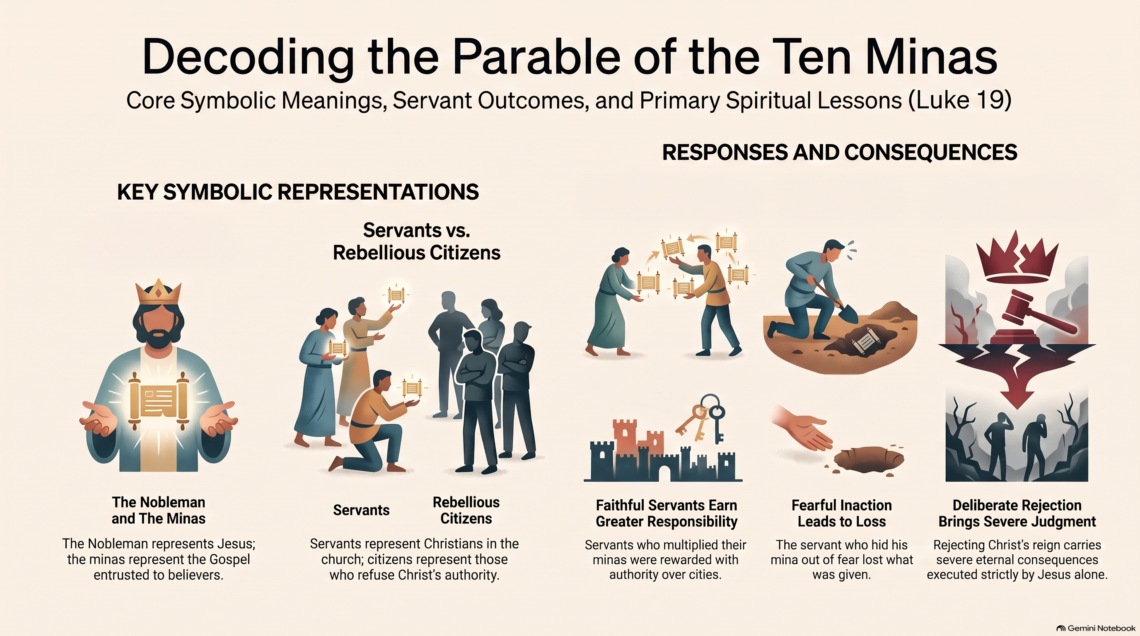
The king represents Jesus, His servants represent Christians in the church, the citizens represent the Jewish people and others who refused Jesus, and the minas represent the Gospel.
When Jesus left, He gave each of His servants the Gospel. We have to observe that Jesus talks about servants. This means that they are in His house—in other words, in the church.
Each of the servants receives the same opportunity to deal with the Gospel and to be a good servant. The first servant gained ten times more, and he received authority in the kingdom of Jesus over ten cities. The one who gained five minas received authority over five cities.
And the last servant did nothing with the Gospel. He hid it in a handkerchief.
This means that he did not tell people that he belonged to the church or that he was a Christian. He denied Jesus by not telling anyone about the Gospel.
Jesus calls him a wicked person and throws him out of His house.
Then we come to the last group: the citizens, who represent the Jewish people who rejected Jesus, or people who deliberately refuse Jesus.
They clearly declared that they did not want Jesus to be their king. This is why Jesus judges them as severely as they had rejected Him before.
Another reason for this severe judgment is that heaven is an absolutely pure place. There is no sin there, and we can enter only when Jesus has washed our sins away.
If we do not accept this and remain in our sins, there is no other place for us in eternity than the lake of fire when Jesus comes again as Judge and King.
I have to mention one important thing:
Only Jesus, who was killed and died for our sins, may execute the judgment described in verse 27 at the end of time, when He will sit on the great white throne.
We as Christians are not allowed to judge anybody or to persecute somebody in the name of Jesus or in the name of our faith. On the contrary, Jesus clearly teaches us to love our enemies, pray for those who persecute us, and bless those who cause us trouble.
4. Q&A Section Based on the 55th Study of Luke
Okay. Based on the Bible study content above, now let me ask Sister Ingrid some related questions.
We hope that the following questions will be helpful to our brothers and sisters.
1. Why did Jesus tell this story near Jerusalem?
Because the people expected that He would soon establish His kingdom, and everybody wanted to know what place or role they would have in the kingdom to come.
2. Where did the nobleman go before he came back?
He went to a faraway place.
3. What did the nobleman give to each of his ten servants?
He gave each of them a mina, which represents the Gospel.
4. What did the nobleman tell his servants to do with the money?
They were to engage in business with the mina.
5. How many extra minas did the first servant make?
Ten. He gained ten additional minas.
6. How many extra minas did the second servant make?
Five.
7. How did the master reward the first servant?
He gave him authority over ten cities.
8. Why did the third servant hide his mina?
He was afraid of the master and did not use what had been entrusted to him.
9. Was the master happy with the third servant? Why or why not?
No. He rebuked him because he had not used the mina that had been entrusted to him.
10. What happened to the mina that the third servant had hidden?
It was taken from him and given to the servant who had ten minas.
11. What does this story teach us about using what God gives us?
We should engage ourselves in the things of God and not be lazy. When someone asks us about our faith, we should confess that we are Christians.
12. In verse 27, whom did the nobleman call his enemies?
The citizens of the town who had rejected him.
13. Why did these people not want the nobleman to be their king?
They wanted to live according to their own will rather than according to God’s will.
14. What did the nobleman say would happen to the people who rejected him?
They would be brought before him and judged severely.
It is important to understand that rejecting Jesus deliberately has eternal consequences.
All people are sinners, just as we all are. Prostitutes, robbers, and people who have committed other crimes will not be saved because they have never sinned. Rather, forgiveness is available to all who turn to Jesus and enter into peace with Him by accepting the gift of His grace, which He offers to us.
15. What important warning can we learn from verse 27?
When we deliberately reject Jesus, it has serious consequences.