Luke 6,12-26
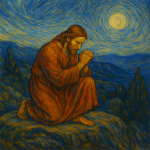

12 In these days he went out to the mountain to pray, and all night he continued in prayer to God.
13 And when day came, he called his disciples and chose from them twelve, whom he named apostles:
14 Simon, whom he named Peter, and Andrew his brother, and James and John, and Philip, and Bartholomew,
15 and Matthew, and Thomas, and James the son of Alphaeus, and Simon who was called the Zealot,
16 and Judas the son of James, and Judas Iscariot, who became a traitor.
Jesus Ministers to a Great Multitude
17 And he came down with them and stood on a level place, with a great crowd of his disciples and a great multitude of people from all Judea and Jerusalem and the seacoast of Tyre and Sidon,
18 who came to hear him and to be healed of their diseases. And those who were troubled with unclean spirits were cured.
19 And all the crowd sought to touch him, for power came out from him and healed them all.
20 And he lifted up his eyes on his disciples, and said: “Blessed are you who are poor, for yours is the kingdom of God.
21 Blessed are you who are hungry now, for you shall be satisfied. Blessed are you who weep now, for you shall laugh.
22 Blessed are you when people hate you and when they exclude you and revile you and spurn your name as evil, on account of the Son of Man!
23 Rejoice in that day, and leap for joy, for behold, your reward is great in heaven; for so their fathers did to the prophets.
24 But woe to you who are rich, for you have received your consolation.
25 Woe to you who are full now, for you shall be hungry. Woe to you who laugh now, for you shall mourn and weep.
26 Woe to you, when all people speak well of you, for so their fathers did to the false prophets.”
Introduction
Hello everyone, I am Kiki. The Chinese name of our second phase of the program is “读经大讲堂.” The English name is “Bible Study.”
We will adopt a relaxed and enjoyable learning mode to take you into a new world of learning. Each time, I will give a personal summary and analysis from the perspective of a learner, and then Sister Ingrid will help us go deeper with further study and discussion.
I hope that this interesting and interactive process can bring a new learning experience to all of you. The following is my interview with Sister Ingrid on related topics. Today is the eleventh lesson on the Gospel of Luke.
Everyone is welcome to leave a message in the comments for discussion!
2. My Summary of the Eleventh Study of Luke
Well, everybody! First of all, here is my personal study summary for today.
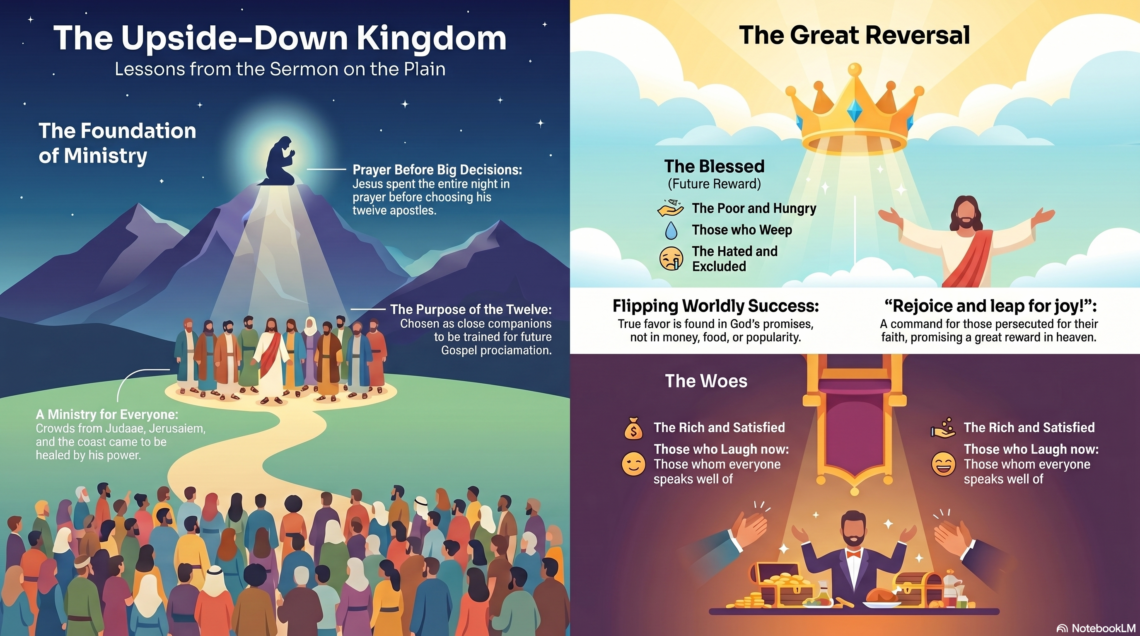
Jesus had just chosen His twelve apostles and then went with them to a level place, where a huge crowd of people gathered from all over to hear Him and be healed.
He looked at His disciples and spoke words of blessing over those who normally suffer in this world: the poor, the hungry, those who weep, and those who are hated because they follow Him.
He promised that although they lack now, in God’s Kingdom they will receive everything they truly need and will rejoice.
Then Jesus warned that the opposite is true for those who have plenty now—the rich, the well-fed, those who laugh without care, and those who are praised by everyone.
Because they already enjoy the comforts and approval of this world, they will face loss and sorrow in God’s future Kingdom.
In this “Sermon on the Plain,” Jesus turns common ideas of happiness upside down, showing that true blessing is not based on money, food, or popularity, but on God’s promise to care for those who trust Him, especially in difficult times.
Now let Sister Ingrid give a further summary.
3. Sister Ingrid’s Comment on My Study Summary
In this text we hear how Jesus chose the twelve apostles. He spent the whole night in prayer before making this decision. This should also be an example for us—to take time in prayer before making important decisions.
The apostles were twelve men who received special training from Jesus. He wanted them to preach the Gospel after His resurrection and after He had gone to heaven. Therefore, they were the closest people to Jesus during His time on earth.
A good question is why He chose Judas Iscariot. The Old Testament says that one of His close followers would betray Him, and Judas chose by his own will to do so. Jesus gave him many opportunities not to do this.
Judas Iscariot is an example that Jesus gives everyone a chance to follow Him—both the good and the bad. Judas chose to become a betrayer, and Jesus did not force him to change.
Then Jesus came down to a level place, and a large crowd from many directions came to Him to touch Him and to be healed, because power was coming from Him. It is like a fountain: you come to a central point where you find water. Here, people did not find water—they found Jesus, who healed them all.
Most people went home, but some stayed to become disciples. To these disciples Jesus spoke the Beatitudes and the woes.
In this sermon, Jesus explains the cost of being a disciple: a disciple may be poor, hungry, weep, and be persecuted.
If this happens to us, we should not be sad, because Jesus said that this would happen and that we will receive a great reward in heaven if we remain faithful. He compares us to the true prophets of the Old Testament.
The woes are for those who try to avoid following Jesus and avoid such situations—those who desire to be rich, who make their stomach their god (as it is written in another part of the Bible), those who seek pleasure, and those who want everyone to speak well of them.
Of course, it is not wrong to have these things—we may have money and food—but the danger lies in putting them above the Kingdom of God. Jesus says in another passage that then we are not worthy to be His disciples.
To be “blessed” was a very strong expression in Jesus’ time, and it caused anger among many people that those whom the world considers low and insignificant are highly valued in the Kingdom of God.
Q&A Section (Based on Luke, Lesson 11)
Okay, based on the Bible study above, let me ask Sister Ingrid some related questions. We hope these questions will help brothers and sisters who have just become Christians.
1. Who did Jesus say are truly “blessed”?
The poor, the hungry, those who weep, and those who are persecuted.
2. Why might the poor and hungry be happier in God’s Kingdom than the rich and well-fed?
Because earthly possessions are temporary. Those who have little can go with joy to heaven, knowing something better awaits them.
A friend of mine once cared for a 104-year-old man. He suffered for four days before he died because his heart was attached to earthly things, and it was difficult for him to let go.
We may have possessions, but we should not attach our hearts to them.
3. What does it mean that “yours is the kingdom of God”?
Jesus describes the reward of following Him. If we follow Him faithfully, we will receive the Kingdom of God at the end of our earthly life.
4. How can someone “rejoice and leap for joy” when they are hated for Jesus’ sake?
We can remain joyful even in difficult circumstances because Jesus promises future joy and comfort that will never end.
5. What warning did Jesus give to those who are rich now?
That they have already received their comfort and reward.
6. How do the “woes” balance the “blessings”?
They present the opposite perspective—showing two different choices in life.
7. In what ways does this teaching turn our usual ideas of success upside down?
It contradicts worldly values like wealth and status, showing that these do not determine true worth in God’s Kingdom.
8. How might someone live out these Beatitudes in everyday life? Give an example.
It is a daily decision: Do I act wrongly to become rich, or do I follow God’s ways and accept limits?
Do I seek joy in worldly pleasures, or in the presence of Jesus?
9. Why do you think Jesus spoke these words “on a level place” rather than on a mountain?
A level place allowed everyone to see and hear Him clearly and decide whether to stay or leave.
10. How does knowing these Beatitudes help you face your struggles?
They give comfort. In many parts of the world, Christians still face persecution. For them, it is a great encouragement to know that something far better awaits them in eternity.